By: Sarah Munn –

Photo: Dave Herholz
Like most things, the concert photography world has evolved since its genesis in the ‘60s and ‘70s.
Renowned rock photographer, Ethan Russell, who will be showcasing some of his best known works in Richmond Hill on March 1st, has witnessed this first-hand and he recognizes its effects on industry professionals.
The way the public consumes photos today has altered the value and rarity it once held. Cameras used to be expensive, elusive pieces of equipment. Now there is a lens in almost every handheld device and good quality point-n-shoots are cheap and plentiful.
“Photography is like language,” says Russell, explaining how photographs are easily shared and used to communicate through social media in a way that was previously dominated by speech. “It’s so fast and so furious and so pervasive that I just see it like words.”
Russell, 67, is famous for not only being the photographer behind the iconic album covers of The Who’s ‘Who’s Next’ and The Beatles’ ‘Let It Be,’ but for also being granted unprecedented access to The Rolling Stones during their 1969 North American Tour where he captured The Stones with their guard down. His serendipitous start in the music business began in 1968 as a 23-year-old expat living in London. Russell became enamoured with the UK music scene and became introduced to The Rolling Stones frontman Mick Jagger. A few snaps later, his career was born, flourishing during the golden age of music.
“Everything was about the music,” he says.
Perhaps the most noticeable change in the music industry from then to now is the shift into mass marketing.
Russell explains that The Stones and The Beatles altered their signature looks without the help of stylists and art directors as there are today. Musicians simply expressed who they were with their haircuts and clothes and shared it with their fans without a hyped-up public unveiling. Today, performers present themselves as packaged products.
“I don’t know who pays for photography anymore.”
“Most of what you see looks like product photography,” Russell says. “TV trumps everything,” he adds, noting the medium as a major cause of the packaging of musicians.
In addition to most of music photography being in a certain advertising style, there are numerous restrictions imposed on the people trying to take unique photographs.
Jason Wilder, 30, is a concert photographer based in Tampa, Florida. In an email interview he shed some light on his experience with restrictions he has faced while photographing concerts.
“I remember shooting Taylor Swift one year,” he recalls. “Professionals could only shoot songs numbered two, three and four.”
Wilder remembers Swift making a costume change for the songs photographers were allowed to shoot, then changing again for the rest of the show. Professionals were unable to capture her in other outfits during the performance, but Wilder noticed someone behind him in the crowd who had snuck in a DSLR camera.
“The problem with this was that while pros were restricted to just one type of photo in one dress that every pro photographer got for the whole tour, this guy got photos of every costume change,” says Wilder.
“I later noticed all the photos from the same show on a paparazzi-type wire service, and the photos were selling all over the Internet ‘cause it was something different from what the pros got.”
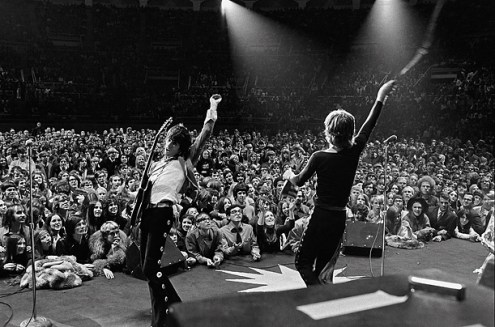
Keith Richards (left) and Mick Jagger (right) of The Rolling Stones – Auburn, Alabama. 1969. U.S Tour. (Photo: Ethan Russell – All Rights Reserved)
Wilder explains that even if the quality of the photos sent in by fans is not the best, many editors will gladly take the photos in exchange for a mere photo credit. An increase in crowd-sourced concert photos is perhaps the future of the industry, he says.
Russell has seen restrictions like these put on photographers too, and says he wouldn’t work under the circumstances many photographers face today.
He remembers watching snowboarding during the Winter Olympics one year, and at one point seeing a pen of about 30 photographers shooting the event. All of them were vying for the same shot, aiming over each other’s shoulders from the same angle, with no room for movement or creativity.
“It became clear to me without any doubt that that job is gonna’ be taken over by a robot before too long. Because there’s absolutely no reason to put a human being in there because a machine could do it better,” says Russell.
Professional photographers also face another problem, he notes – the issue of retaining the rights to their art. Photographs were once valued for their uniqueness, but today identical photographs flood the market. Getting paid and being duly credited is now the foremost dilemma for the modern photographer.
“I don’t know who pays for photography anymore,” says Russell, explaining that often, when companies do pay, it’s in a contract that gives the rights of the photograph to the company, taking them away from the person who created it.
“Never sell yourself short. Stand your ground. If someone wants to use your photo, that means it has value to them.”
Not only do these limitations hurt photographers, Russell muses, they also hurt history.
“You don’t shoot the history, there’s no history to show,” he says.
So what’s the future of the industry? Can professional photographers still make a career in concert photography? Both men agree that’s a difficult path to choose.
“There is always a place for new talent pushing the boundaries and doing something amazing,” says Wilder.
“But in the music industry, the problem is getting their foot in the door to be able to use their creativity. No one trusts photographers anymore and that is one of the reasons for tighter restrictions.”
Though it is a tough career path, many people love it for the creative freedom it gives them. And there is success to be found as a photographer, it’s just not easy success. Russell suggests having another job to support yourself while pursuing your photography.
Wilder also offers advice to those who want to go for it. “Never sell yourself short. Stand your ground. If someone wants to use your photo, that means it has value to them. Never work for free or credit, unless it’s for charitable reasons.”
Ethan Russell will bring his Best Seat in the House show to the Richmond Hill Centre for the Performing Arts on March 1st. Click here to reserve your seat to see almost 400 of his photographs. If you can’t make it, keep an eye on us for our coverage of the event!
 Aesthetic Magazine | Album Reviews, Concert Photography, Interviews, Contests
Discussion
Trackbacks/Pingbacks
Pingback: Field research: live music photojournalism – Jen's photojournalism - February 19, 2019