By: Curtis Sindrey –
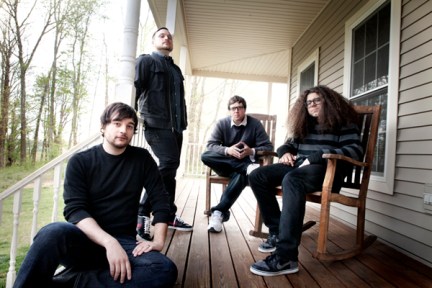
When New York-based progressive rockers Coheed and Cambria released The Afterman: Descension in February, the second and final release of a sprawling double-album, they launched fans into another world, which chronicles the Amory Wars storyline and follows Sirius Amory, and with a culture that consumes MP3s rather than albums, or concept albums for that matter, it failed to make the band compromise their ambition to satisfy the iGeneration.
“Music deserves attention and for people to be more appreciative of where it comes from,” guitarist Travis Stever tells Aesthetic Magazine Toronto. “And The Afterman is a double record and it was purposely put together that way so when someone just wants one or two songs it’s annoying, but I’d rather have somebody like one of the songs then none of them, but at the same time, you wish that people gave more of a chance to the album again.”
While much of the backstories of their albums are a priority for the band, the songs often take precedence.
“Claudio [Sanchez] is still writing from life experiences, but he just paints it as a picture that has a story attached to it,” Stever says. “The real life dictates the fiction and that’s what happens with him, but the music and the concept can also be very separate things and it’s really rare that he’ll say ‘in this part of the song is this really amazing scene that we have to create with music’ it’s more like what’s going to sound good and what’s best for the song, which always comes first.”
The Afterman brought Coheed and Cambria’s line-up full circle with the return of drummer Josh Eppard who replaced Chris Pennie, who last appeared on 2005’s Good Apollo, I’m Burning Star IV, Volume One: From Fear Through the Eyes of Madness. The Afterman is also the first album to feature former Am To Am member Zach Cooper, who successfully completed an audition for the band, and replaced Michael Todd after police charged him with armed robbery in July 2011.
“Josh actually played in a band with Claudio’s cousin and we had played with them earlier in our career,” Stever explains. “With regards to Josh returning, we built the band on the original group, so in a way that was just fitting back into that groove and he brought a new energy to the band.”
“Josh is a different player and with that does come the change but it’s a good change and the band is the best that we’ve ever been, but that doesn’t take away from anyone that has played with us before because I couldn’t be more thankful and more proud to play with the musicians that I’ve had the chance to play with.”
“If you aren’t challenging yourself what the fuck are you really doing?”
With The Afterman, Coheed and Cambria felt an obligation both to their fans and to themselves to challenge their perceptions of what they were suppose to sound like.
“We just wanted to evolve,” Stever says. “And also represent our whole career on these records and what we’ve been all these years and we wanted The Afterman to be everything and more.”
With the history of double-albums, there is an extensive list of some of the most influential releases. Stever says that his top five list of his favourite double-albums of all time are Led Zeppelin’s Physical Graffiti, The Who’s Quadrophenia, The Smashing Pumpkins’ Melon Collie and the Infinite Sadness, The Beatles’ The White Album, and The Clash’s London Calling.
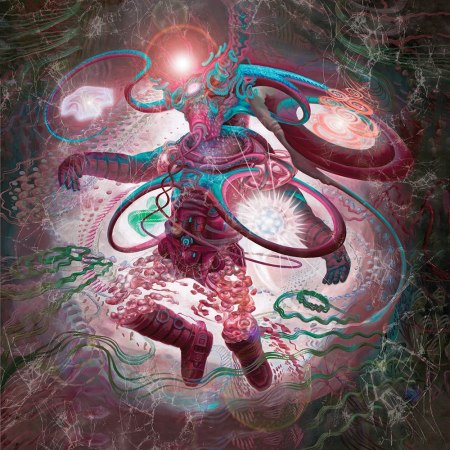
Coheed and Cambria recorded The Afterman: Descension in tandem with The Afterman: Ascension (released in October 2012) and paired them as a double album, all while in the midst of significant line-up changes, including the depature of drummer Chris Pennie and bassist Mic Todd.
“I know a lot of people had mixed feelings about [Melon Collie and the Infinite Sadness],” he says. “And beyond that look how many hits it had so the proof is in the pudding with that. There are also a lot of hidden gems on that record.”
“[The White Album] is the ultimate [double-album]. Lately we’ve got into playing it in the dressing room and everybody sings along [with songs like] “Rocky Raccoon,” “Bungalow Bill” and “Happiness Is A Warm Gun,” which is one of my favourite songs in general.”
Stever’s parents met while both of them were performing in an off-Broadway production of Jesus Christ Superstar, and as he grew up, his parents, especially his mother, shaped the way he viewed music and inspired him to explore the music that spoke to them.
“My mother got fed up with the atmosphere of the music world so she doesn’t play music anymore,” Stever explains. “When I was growing up, I’d get a glimpse at how beautiful her voice was. Also, if my father weren’t continuously trying to pursue music in my upbringing, I would never have wanted to try myself.”
“My now wife, when we were dating, she stayed over at my house when I was living at my mother’s at the time and my mom was flipping pancakes she just started singing “my name is Lucifer, please take my hand” [from Black Sabbath’s “N.I.B.,” from their 1970 self-titled debut album] and the reason that I got into Black Sabbath was because I found their first album in my mother’s record collection in our living room, and she saw one of the first Sabbath concerts in America, and she just really loved their music, so that’s where I came from.”
With his side-project Davenport Cabinet, formerly The English Panther, Stever maintains a musical outlet that has allowed him to not only evolve as a songwriter and vocalist, but he has also developed higher standards for his music.
“I just continue to make music no matter what,” he says. “And you’d figure that after a six-week tour that I would just want to go home and put my guitar down, but it’s apart of my everyday thing and I’m lucky because people have a hobby and a career and I get to do both. Music is very therapeutic to me and I get to release things in it.”
“[Developing as an artist] has been a natural thing and vocally it had to do with being around an incredible vocalist like Claudio and just taking it upon myself to be better. With The English Panther, I used to record things and throw them up online and there’s something that’s cool about that, but as I’ve gotten older my standards are much higher because if you aren’t challenging yourself what the fuck are you really doing?”
 Aesthetic Magazine | Album Reviews, Concert Photography, Interviews, Contests
Discussion
No comments yet.