By: Patrick Topping (@ptopp_ing) –
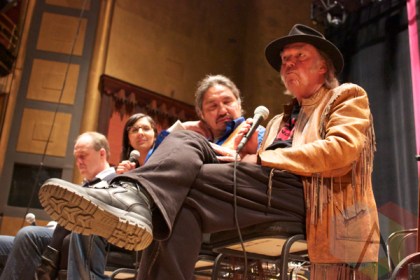
Neil Young. (Photo: Curtis Sindrey/Aesthetic Magazine Toronto)
Iconic Canadian rocker Neil Young kicked off his Honor The Treaties tour on Sunday as he spoke to reporters at Massey Hall to preface the Robin Hood-styled concert with a candid panel discussion on the impact of oil-sands industry development in Athabasca Chipewyan First Nation (ACFN) territory in Northern Alberta.
As a group of men from ACFN performed a brief multi-tonal chant and pounded on a large drum that echoed across the ornamental Art-Deco auditorium, a tribe’s elder-woman delivered a welcoming blessing with special acknowledgements to “uncle Neil” and “aunt Diana [Krall]”. Renowned scientist and professor David Suzuki moderated the panel on which guests offered scaled perspectives on the issue: from the local ACFN, the forthright Chief Allan Adam and ACFN’s impassioned communications coordinator Eriel Deranger; to Canada’s fluctuating global climate change policy via Andrew Weaver, a scientist formerly with the Intergovernmental Panel on Climate Change, to the reflectively expansive performer Neil Young.
Chief Adam began the discussion and thanked the First Nation community in Mississauga for allowing his tribe to visit their territory, a subtle gesture to the longstanding heritage between indigenous populations that pre-date modern-day metropolises. Chief Adam discussed the tribe’s historic co-operation with the Canadian government and petroleum industries for potential financial benefits, until toxic waste-water reservoirs spilled into the Athabascan waterways, breaching the partnerships. When the water quality degraded and potentially caused observable health issues, the band grew concerned towards the unsustainable pace of development in concurrence with the Harper administration’s gutting of environmental protection measures. Chief Adam invoked an analogy of a “runaway train without a conductor”, while Young recalled his observations of the current state of oil-sands mines in the area as a “devastating environmental catastrophe”.
The current legal actions by the ACFN are in response to the government’s premature approval for Shell’s future development on over 7,000 hectares in the Athabascan wilderness. The proposed mitigation measures attached to the project were nothing more than “lip service”, explained Eriel Deranger, with little-to-no enforcement capabilities to protect the ACFN despite longstanding treaties and constitutional protections. The legal actions are part of a handful of ongoing initiatives including a request for statutory review of regulatory processes by the provincial and federal governments, with the intent that the ACFN would become a part of project review when directly pertaining to their territories. Meanwhile, the legal standing of the treaties stand as an ongoing agreement between all Canadians, not just First Nations people, remarked Chief Adam, and that impinging on the treaties represented a violation by the government against all of its constituents.
The broader issues surrounding the impact of resource-harvesting industries on First Nations’ territories and populations extends into economic disparities, cultural relativism, and environmental policy, but Young sharply underlined the fundamental narrative as a “basic matter of integrity on the part of Canada.” Drawing a pointed comparison to George W. Bush-era politics of “trading integrity for money”, Young illuminated the country’s identity-crisis teetering between capitalist-driven conservative leadership versus the nation’s progressive reputation for multi-cultural affirmation and environmental stewardship. He further commented on the current administration’s faltering on environmental progress, “our future depends on science. Science is the road map. Science cannot be ignored as inconvenient, and that’s what today’s leaders are doing, and that’s why I’m here.”
Young concluded the brief Q&A session with a propulsive and optimistic remark, “we have the chance to change the speed of change… if you are looking forward, instead of at what’s just in front of youright now… there is a door that can open into the sunshine”. Young will continue his series of Honor the Treaties concerts in Winnipeg, Regina, and Calgary this month.
In the meantime, you can take direct action through financial contributions by visiting DrawTheLine.ca and by staying up-to-date to the ongoing progress of the ACFN’s initiatives.


 Aesthetic Magazine | Album Reviews, Concert Photography, Interviews, Contests
Discussion
No comments yet.