By: Patrick Topping (@ptopp_ing) –
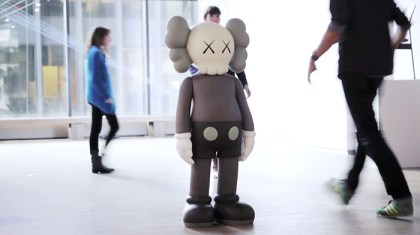
Derek Shapton – Kawa Companion
The Design Exchange (DX) in downtown Toronto hosted a media preview for their upcoming “This is Not a Toy” exhibit yesterday. The exhibit celebrates the “urban vinyl” medium in pop and hyper-pop art, largely brought to public renown by international artists like KAWS, Los Angeles-based collective FriendsWithYou, and the celebrated Takashi Murakami, whose work adorned the artwork of Kanye West’s 2007 album Graduation. Many of the exhibit’s pieces borrow from guest curator Pharrell Williams’ personal collection.
The curatorial instigator John Wee Tom, a Toronto boutique-hotelier, and co-curator Sara Nickelson, DX’s Collections Director, guided the sartorial group of journalists, bloggers, and media through the vibrant, colourful, and temptingly tactile exhibit in the brightly lit second floor space. During his presentation, Tom acknowledged the “ubiquitous, generous, and creative whirlwind” that is Pharrell, who played an invaluable role in bringing the pieces to their inaugural appearance in a Canadian gallery.
Whimsical sculptures lined the room, their sizes ranged from handheld to a small-child, and demonstrated the format’s expansive breadth of influence, drawing imagery from anime, to music and fashion, represented by a Chanel patterned bear. Among the more prominent pieces is a Murakami/Pharrell collaborative sculpture titled “Simple Things”, a glistening black bubble-head with its mouth viciously agape to reveal a rainbow mouth holding a can of Pepsi and other day-to-day items emblazoned with rubies, sapphires, and emeralds, caged behind menacingly protruded fangs. Throughout the room, the mouse/bear-like sculptures known as “kubricks” by KAWS bore iconic resemblance to Disney cartoons, Star Wars, The Beatles, Daft Punk, and Japanese manga, but with subtle-psychedelic permutations in their shape or material elevated the works beyond consumerist mass-production.
KAWS also created a large-scale robust wooden sculpture of a groggy Mickey Mouse avatar laid on the floor with a cigar in hand, appended with the artist’s trademark ham-fisted ears and X’d eyes cast in a downward stare. Curator Tom beamed that the piece was exclusive to the exhibit, having been completed in Belgium just weeks before the opening. Many of the artists and companies featured in the show are from international backgrounds, and the curators noted that the medium has yet to ignite in Canada. To spark the format, DX invited Canadian designers to contribute a “munny” or series of “munnies” (ready-made miniaturized creature sculptures), and organizers collected the pieces on shelved platforms that align an offshoot corridor of the space.
“This Is Not a Toy” cleverly presented the playful works in a gallery setting to subvert any stodgy divisions between ‘art’ and pop-culture, and while many disregard the form as “lo-brow”, the artists champion the imagery of pop-culture by subtly marring overt patterns of consumerist pageantry through mischievous nuance, and even l’humour noir. These quirks enable the audience to identify with the imperfections, and project a sense of narrative onto the form. This personification, Nickelson expounded, shifts the power dynamics from the creator and their creation, to the relation between consumer and an object. It sounds heady, but it’s a visceral reaction of immediacy that induced gleeful coo’s and awed delight from the small group, who were quick to divvy-up favourites. It’s also the same defiance and playful exuberance that underscores how Pharrell can instil a “human” feel to a proggy pop-disco album made by “robots”, and why Kanye can insist that he’s not making rap music, but making pop culture.


 Aesthetic Magazine | Album Reviews, Concert Photography, Interviews, Contests
Discussion
No comments yet.