By: Patrick Topping (@ptopp_ing) –
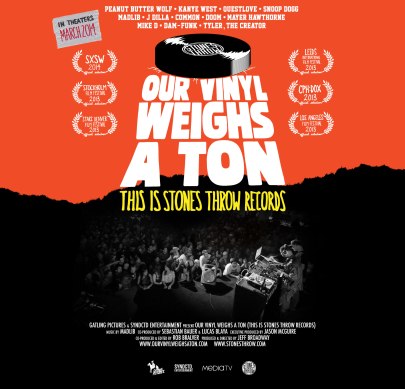
Last Friday, the Bloor Hot Docs cinema hosted a one-night only screening of the music-video styled documentary Our Vinyl Weighs a Ton, about the Los Angeles-based just-left and far-left-of-centre hip-hop and psych-R&B label. The evening including a special Q&A with label-head DJ Peanut Butter Wolf, née Chris Manak, who earnestly acknowledged the eager crowd of beat-heads and vinyl collectors before the screening, expressing that the tour’s “biggest audience” was in the theatre on this night despite the unfriendly weather.
The film captures Stones Throw’s obscure-savant and collaboration-centric aesthetic through a chaptered structure that provides the marquee of guests with headspace to ruminate. The film frames biographic and reflective interviews with grainy, saturated home-videos and psychedelic cartoon visuals inspired by loudmouthed, pipsqueek-voiced Quasimoto, the alias of label mainstay artist Madlib, whose lush shuffled jazz-sampling beats soundtrack the film. Rest-assured that when Bloor Hot Docs Cinema promised a loud volume, the audience wiggled, bobbed and nodded along in their seats.
The film enters its Prologue on December 12, 2012 en media res a 12-hour Peanut Butter Wolf DJ-set at one of the label’s infamous synchronicity events (another such storied event was on November 11th, 2011 where Wolf hosted an 11-hour, 11-guest, all-vinyl DJ event culled from his own collection). The story positions Manak as the focal point and the centre of the music community, as cohorts and friends celebrate their indelible fingerprint impressions on West Coast hip-hop, carved through an attitude of “embracing the unembraced”, remarked drummer Ahmir Thompson, a.k.a. ?uestlove.
The story of Manak’s progression from a teenager dabbling in mixtapes and New Wave bands to a promising hip-hop career through his adolescent collaborations with Charles Hicks, a.k.a. Charizma, before his tragic death at the age of 20 initiates the story of Stone’s Throw. Various hip-hop personas, including Talib Kweli, Common, Tyler the Creator, Earl Sweatshirt (cradling an owl figurine), and Kanye West reflect on the label’s roster, including the R&B live band Stepkids; post-psychedelia dollar-bin scrounger James Pants; the colourful, syncopated beat maker Jonti; and the people’s champ Madlib, who the film captures striding to a DJ podium in a cinematic Scorsese-worthy long shot.
Madlib’s masterful post-impressionist beat artistry carries the heft of the story, his insatiable hunger for sonic nuance and character lending him the stature of a sonic warrior. Geoff Barrow of Portishead decrees him to be the “Zappa” of Stones Throw. The unique inclusion of intimate footage of Wolf working tenaciously behind Madlib to orchestrate collaborations with the pulp-noire masked rapper MF Doom on the heady, hypnotic Madvillainy, and with the prominent Detroit beat-master J Dilla, resulting in the bolstered collaboration between the cosmic brothers-in-arms on Champion Sound, shows the height of a label in its Golden Age. Dilla’s final works weave into the story, as his emergence in L.A. has gained a religious zeal. Common, ?uestlove, and Flying Lotus (a former Stones Throw intern) reflect on his wildly productive era by praising his exhaustive ethics and instinctual knack to push the constraints of rhythmic-phrasing. Throughout the film, Kanye’s noxious poetic waxing fumbles and flails, but even here he finally settles into a rare moment of earnest, albeit potty-mouthed, reverence.
The passing of Dilla was a marked tragedy for the hip-hop community, and for the label whose artists had burnished that mantle, it was an identity crisis. In a period marked by more outlandish repertoire choices, Manak delved into psychedelic and synth music, and forged the label’s broader visions of catering to their vinyl archivist and collector attitudes. Through several daring choices: giving a debut box-set release to brash Prince-funk aficionado Dam-Funk; pushing intern Mayer Hawthorne to pursue his nerd-soul persona; and discovering Aloe Blacc’s smash-hit “I Need a Dollar” (though in the Q&A after the film, Manak made clear that he doesn’t lay claim to that discovery), Wolf’s dogged perseverance pays off and establishes the brand as a tastemaker and a bastion of creativity.
After the film, Robin Smith of Bloor Hot Docs Cinema hosted a Q&A with Chris Manak and PR rep Eric Alper. All three perched at the front of the stage as the audience excitedly posed questions lending an awe-struck fanboyishness and overtly conversational tone. Manak is known better for communicating through his turntables, his vocabulary consisting of unearthed vinyl finds, but removed from this podium, he seemed unsure of how to answer most questions, opting instead for playful sarcasm. He mentioned his two favourites Toronto record stores being Kops and Cosmos and recounted a meaningful story of his experiences with Dilla during his final days. (Editor’s note: Manak revealed via social media that his father had suffered from an undisclosed prolonged ailment and passed away in the 24-hours following the Q&A. He expressed his condolences and appreciation for the support that his father had given to him throughout his career.)
The film vacillates between documentary and long-play music commercial, and the literary construct of chapters is an empty-handed deceit when there is no conclusion or broader message about independent labels in the modern music industry (maybe a mixtape structure would have made more sense?). However, the narrative moves like a turntable stylus in the grooves of the label’s story, occasionally skirting across the surface but finding poignant depths in the untimely tragedies and inevitable exiting of artists, friends and extended family, imbuing purpose for a determined and resourceful curator to continue the story. For talent like Peanut Butter Wolf, Madlib, and Dilla, the wobble and etched grooves of a warped LP is an opportunity to emphasize and express genuine character possessed by their materials.
 Aesthetic Magazine | Album Reviews, Concert Photography, Interviews, Contests
Discussion
No comments yet.