By: Curtis Sindrey –
Follow @Aesthetic_Mag
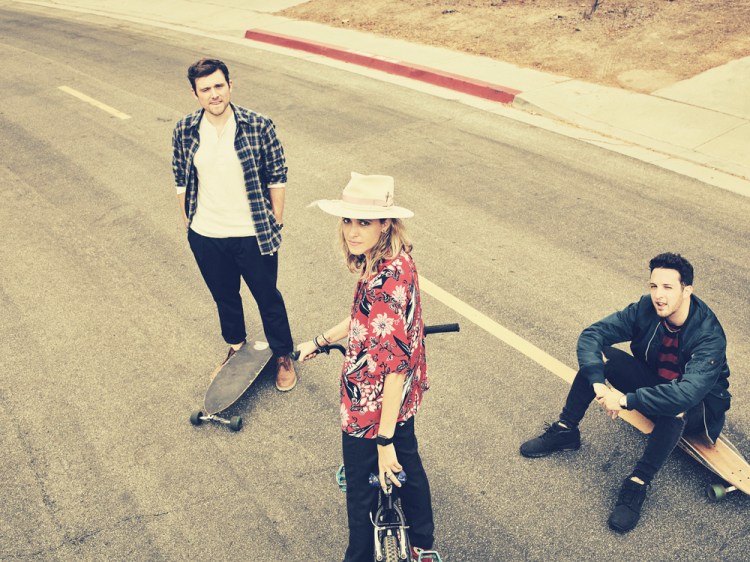
Ocean Park Standoff.
Each of the artists behind L.A.-based alt-pop trio Ocean Park Standoff comes from a world all their own. A self-taught producer who built his own studio in the basement as a kid, Pete Nappi constructs deeply inventive productions equally inspired by art rock and underground hip-hop. A longtime DJ known for spinning at high-profile gigs around the globe, Samantha Ronson is also a songwriter/multi-instrumentalist who matches her lyrical smarts with a sonic ingenuity rooted in her fascination with obscure vintage instruments. And as a classically trained vocalist, Ethan Thompson has revealed his refined song craft in penning hits for major artists and performing at singer/songwriter hotspots around L.A. On their debut, self-titled EP, Ocean Park Standoff bring those distinct sensibilities together to dream up a sound that’s both intricately composed and undeniably heart-driven.
In our new interview, Ocean Park Standoff discusses the making of their hit single “Good News”, releasing EPs vs. Albums, minimalistic cover art, and more!
You released one of your most popular tracks “Good News” a few months ago. What was the creative process like for it?
For all of our sessions we bonded as friends before we ever started working on music. We just talked for an hour or two about what was going on with different things in our lives, and that was one of the days where we were talking about the particular negative things that were going on in our lives. Samantha was sitting there playing guitar as we were sitting there talking, and after we were talking for a bit, we started singing the hook over Samatha’s guitar and it just grew from there. We wrote the song in about an hour and a half, and we turned it into a production in the next couple hours and that’s pretty much what we wrote that day was the song.
Tell me about the inspiration behind the band name? It sounds like something from the local news.
We were trying to get to Samantha’s house, but all the streets were closed. When we looked online later, it said there was a standoff between police and someone with a shotgun on the corner of Ocean Park and 10th street.
You released your self-titled debut EP back in March. What made you want to release an EP over an album?
We wanted to dip our toes in the water as a band. At the time those particular five songs really represented us and they were the songs we played for our early shows, so we thought that those songs would be the best to share first. And that’s how we feel about our next EP in the sense that the songs we’re playing live now with the longer set we have now, those are the next songs we want to share.
The EP cover art is pretty minimalistic. What do the three lines represent?
We went through a bunch of different ideas for what we wanted to use for the cover, but we wanted something that was simple, and we didn’t want to distract from the music. We didn’t want to make a piece of art that would visually take away from the music itself because we want people to derive their own feelings and put their own stories into the music that we’ve been writing but we wanted to keep the cover art super simple.
Samantha, you come from a DJ background. What was the transition like going from the DJ world to a band setting?
As a DJ, I’m up there playing other people’s music, so I’m basically a human jukebox, and it’s two completely different worlds.
Ethan and Pete, you guys worked with such artists as Shawn Hook, Shinedown, The Chainsmokers, and Kesha, among others. How do you approach working with other artists vs. collaborating on a project like Ocean Park Standoff?
For Ocean Park Standoff, the main thing is that we try to make sure that it’s true to all of our stories because if you look at the lyrics that we put out, they represent all three of our stories.
When we write for other people, I think it’s more important that the idea and concept of the song is as generic and wide-spread as possible so anyone can sing it. And when we’re doing our music, it’s more about following our stories as well as we possibly can.
 Aesthetic Magazine | Album Reviews, Concert Photography, Interviews, Contests
Discussion
No comments yet.