By: Jeff Weiss –
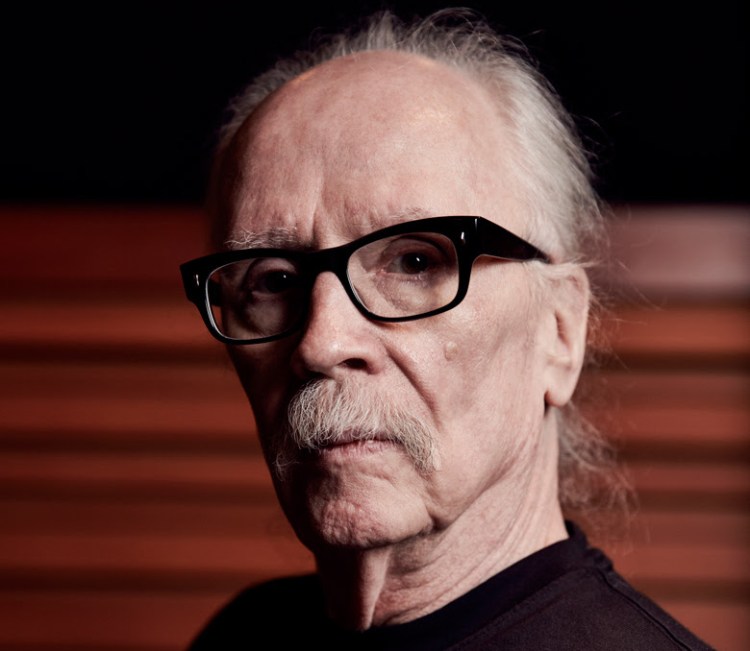
John Carpenter. (Photo: Sophie Gransard)
John Carpenter is set to release Anthology: Movie Themes 1974-1998, a collection of 13 of his classic movie themes newly recorded with the collaborators that worked on his Lost Themes albums, next Friday, October 20th via Sacred Bones.
On the new album, Carpenter is joined by the musicians that accompanied him on his last two releases and subsequent tours: his son, Cody Carpenter, and godson, Daniel Davies. Anthology… is a near-comprehensive survey of John Carpenter’s greatest themes, from his very first movie (the no-budget sci-fi film Dark Star) to 1998’s supernatural Western, Vampires. Those sit alongside the driving, Led Zeppelin-influenced Assault on Precinct 13 theme, Halloween‘s iconic 5/4 piano riff, and the eerie synth work of The Fog. Carpenter and his band also cover Ennio Morricone’s bleak, minimalist theme for The Thing.
John Carpenter is a legend. As the director and composer behind dozens of classic movies, Carpenter has established a reputation as one of the greatest filmmakers in the history of modern cinema, as well as one of its most influential musicians. The minimal, synthesizer-driven themes to films like Halloween, Escape From New York, and Assault on Precinct 13 are as indelible as their images.
In a new interview, Jeff Weiss talks to the iconic filmmaker about “Halloween”, releasing albums in your 60s, and more!
Jeff Weiss: Since you started releasing the Lost Themes the obvious question that every journalist probably asks you is what led to the decision to go into the music, releasing albums in your mid 60s.
John Carpenter: Well late 60s (laughs), it started as improvisations between my son and I. We’d play video games, we’d go downstairs and make music, we’d go play video games again, we’d make more music. They were little snippets of a score, like a soundtrack sampler, so that’s where it started and what it is basically. I think the Lost Themes are the themes for the movies in your mind. The movies you make up yourself.
JW: Did you ever have a theme before you shot the movie?
JC: No always after
JW: What about when you were writing it, were there other kinds of inspirations that would float in?
JC: Not really. Movie scoring for me started when I was a student filmmaker and when you are a student you don’t have any money. You can’t afford to hire an orchestra. You just can’t do it. One thing you can do however is get ahold of a synthesizer and do multi tracks and sound big and sound slightly more orchestral than a piano.
JW: It was the early days of the synthesizer; Kraftwerk was just coming out with the fusion stuff. Were there any kind of specific musical inspirations for these first scores?
JC: Not particularly. The sounds of Switched-On Bach probably were more than anything. Just because that was the machine equivalent of Bach so I thought that was really interesting.
JW: Do you remember when you bought your first synthesizer?
JC: I never really bought one, I always used other peoples. I have them now.
JW: Do you think it’s worth repeating the story of your lawyer?
JC: Sure, I was doing the improvisations with my son and when he went off to Japan I had almost an hour’s worth of music. My music attorney said “do you have anything new” and I thought well ok I have this and I sent it to her and a couple months later I had a record deal. It was astonishing. Astonishing.

John Carpenter on the set of ‘Halloween’ in 1978.
JW: With a good label, too. Sacred Bones has put out a lot of great stuff. It’s interesting because a lot of the stuff put out on Sacred Bones was obviously inspired by your work in a roundabout way and it kind of came full circle.
JC: I haven’t thought of that. I’m not familiar with a lot of the electronic scene just littles bits and pieces here and there. But I’m really happy with their release of our stuff.
JW: When you were young were there any scores that stood out from the 50s 60s etc.? I know the Hitchcock films played a big role.
JC: Yes Hitchcock. The composer was Bernard Herrmann and he was big time for me. He also did The Day the Earth Stood Still which was a really memorable score. But there were others. Hammer Films was a British company that released The Creeping Unknown, The Horror of Dracula and The Curse of Frankenstein and the music in those films and most of the Hammer movies were done by James Bernard who is really influential, I love his music. But then I love the traditional guys like Dimitri Tiomkin, I mean he did some amazing things.
JW: One of the things I think I’ve always liked about your scores is that they kind of obliterate the arbitrary binaries people have between highbrow and lowbrow.
JC: “Arbitrary binaries” wow can I use that? I really dig it.
JW: I’d be honored.
JW: With a movie like Escape From New York, one of my favorites of all time, the only thing that matters is what it does to your imagination.
JC: That’s absolutely true. Some of the greatest music that I’ve heard was from the cheap ass science fiction and horror movies. It was really effective stuff and some of the big orchestral scores of those days were a lot less so. You are really affected most by scary movies when you are young and in your pre-teens and teens.
JW: That’s when your imagination is wide open and then it shuts.
JC: Or you can start imagining it happening to you and then it’s not fun anymore.
JW: Everyone is influenced by Morricone.
JC: Yeah everyone was. He was a really experimental composer, that’s where he started, so his stuff for the westerns was truly groundbreaking, so different. Now it’s in commercials, they are stealing the sounds. The score for Once Upon a Time in the West is one of the greatest scores of all time. Unbelievable, it’s so beautiful. It’s everything, it’s legendary, it’s an opera of the old west and the music fulfills that function.
JW: I liked when you were talking about the old King Kong and Mickey Mouse scores.
JC: Max Steiner was the composer of that, groundbreaking in his own way. He did a lot of Mickey Mouse. I’m not sure whether he started with King Kong or Disney’s Sorcerer’s Apprentice. Everything in King Kong is scored. The sounds of King Kong walking, bum-bum-bum, the sounds of the T-rex, every movement is scored. It tells you what you are seeing. It’s a different kind of approach than the stuff that I did.
JW: The lighting in your films is pretty minimal, you leave a little something, is that wrong?
JC: You are absolutely right.
JW: Was it innate, something refined?
JC: It was because I didn’t have the talent to do anything else (laughs). I had limited chops as a musician so I had to get by on a lot of cheating with chords and drones and such.
JW: Every artist has limitations, even Beethoven.
JC: Not many.
JW: I guess the deaf thing.
JC: Which is astonishing.
JW: Your first instrument was the violin?
JC: Oi, yes my father decided “I think it’s time for you to learn the violin.” The only problem was I had no talent what so ever. It was miserable. It’s the hardest instrument to learn how to play because you have to have control of your fingers and arms and everything and the bowing; it’s very difficult. That was a lot of pain, it was not fun.
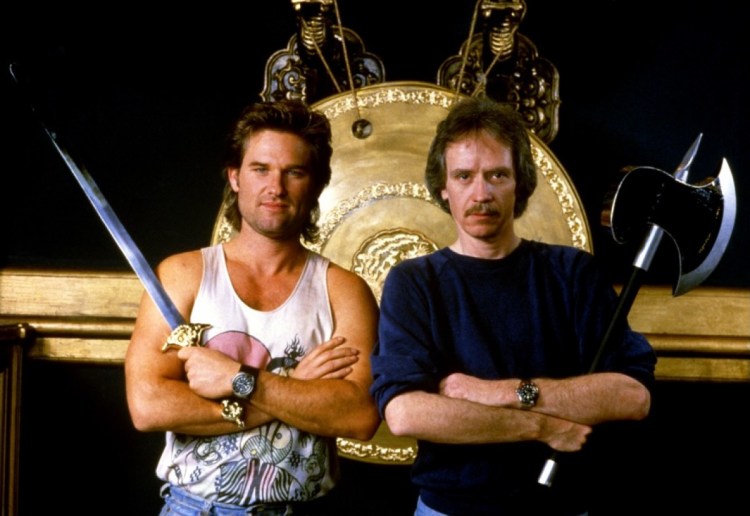
John Carpenter on set with Kurt Russell.
JW: Did that dissuade you from wanting to play music as a career?
JC: Well piano was easier and then I learned to play the guitar and that was fun because I grew up in the 60s and the Beatles came around with guitars and I was crazy about them so I learned to play. It didn’t dissuade me it just taught me that if you are going to learn to play a string instrument, play it on a synthesizer or keyboard.
JW: I remember reading that you were 11 years old when Buddy Holly died and that struck you profoundly.
JC: I had no idea who he was or is, I don’t care for his music. Elvis was the guy. I saw him on the Ed Sullivan show of ‘66 when they shot him from the waist up and I was sitting there watching him at eight years old and it was unbelievable, he was the King.
JW: Your father was a professor at Western Kentucky at the time, right?
JC: Yes, and he was a violinist but he played the piano. Nashville was 65 miles from Bowling Green so he played in the Nashville symphony. And the recording studios down in Nashville doing pop music and country music went searching for string players and they got my dad so he was one of the original players in the Nashville sound. Roy Orbison, Brenda lee… Her song “I’m sorry,” that’s my dad.
JW: Did you ever get to meet any of them?
JC: Hell yes, I was right down there. Roy Orbison always wore sunglasses, I have no idea why, and the guy who came in to sing harmonies with him also wore sunglasses and they got around this mic and they sounded identical.
JW: Did you go to Memphis as a kid and did you get exposed to any of that?
JC: No that was later in my life. Memphis came when I was making this movie about Elvis. We went to Graceland to look it over and what a disappointment. I thought “What the hell is this?” It was cheeseball.
JW: As you got older Elvis sustained his appeal and you made a movie about him. What was it about him that sustained that appeal for you?
JC: Well he changed everything. He changed the style of music that was going on. He just swept in and changed it. He brought country music and rockabilly and yet it wasn’t country rock and his voice was incredible especially in the beginning. And he ended up just sort of floating through the movies and his later releases but in the beginning he did some incredible stuff.
JW: And his dancing.
JC: Yeah, his dancing in Viva Las Vegas is incredible.
JW: I’ve never seen it.
JC: What the hell is wrong with you?
JW: Obviously you are a child of rock and roll but your film scores are pretty different. Did you ever think of making a more rock inspired score or was it through necessity that you would always used the synth? Or did you think it wouldn’t fit the mood?
JC: Some of the scores when we preform them live are rock and roll songs.
JW: In the Mouth of Madness for sure.
JC: Yeah but also Christine. Escape From New York is just a mid-tempo kind of rock and roll thing. All of my scores are informed by the Beatles and the Stones and the riffs and the sounds of that time. They are all informed from there.
JW: I just read Keith Richards autobiography, did you read it? It was pretty amazing I thought for a rock autobiography…
JC: He claims he wrote satisfaction in his sleep, bullshit. They are all blues songs refashioned.
JW: There is some Led Zeppelin working its way into these new songs that you did.
JC: Well the main theme from Assault on Precinct 13 has two influences: one is Led Zeppelin, The Immigrant Song, and the second one is Lalo Schifrin and the Dirty Harry score who I think borrowed from Led Zeppelin.
JW: Did you ever see Led Zeppelin?
JC: No.
JW: The Stones I imagine?
JC: Oh yeah, oh yeah.
JW: Before doing the first Lost Themes record had you worked with your son doing any kind of musical endeavors before?
JC: Only just causally for fun. We’d play together for fun but nothing like now; we are touring together. My godson and son we are up there playing together. It’s amazing. I never thought I’d have another career. I thought movies was it.
JW: Did you and your father ever do any musical collaborations?
JC: We did; they weren’t the greatest. I played piano he played violin. We did a duet on violin together. I just wasn’t good enough. He was but I wasn’t. He was extraordinary.

John Carpenter directs Adrienne Barbeau on the set of ‘The Fog’ in 1980.
JW: Did you have a pretty rigorous musical education because of that?
JC: Not really, I don’t know how to read music. I did, but I’ve forgotten how to do it now. I think that has something to do with the violin lessons, I hated it so much I rebelled.
JW: So, your musical experiences have been just instinctual?
JC: That’s all it is; it’s all instinctual
JW: When you started doing your first scores was there a learning curve? Because I hear them and they sound pretty full formed.
JC: They are just “Bang, here we go! This sounds good, this sounds like this movie, this sounds like this scene.”
JW: Were you getting attention for them early on?
JC: No, hell no. No one paid attention for a long time and I never knew they paid attention when they did.
JW: Was it really Halloween when people started to pay attention?
JC: That was such a strange experience because that was a word of mouth movie, so it grew. Initially it was bad reviews and bad box office but that movie grew and grew and grew by word of mouth. And I’m not sure when the music got noticed, but it was later.
JW: When you were young was there the notion of the cult artist or is that something that didn’t really exist in the 60s?
JC: I don’t know what that means still.
JW: It’s like that Jerry Garcia quote, “Not everyone likes licorice but the people that like licorice really like licorice.”
JC: That makes sense.
JW: What spurred the decision to rework these songs with your son and godson (for Anthology)?
JC: We just wanted to do an album of movie scores and maybe choose ones that people hadn’t heard or hadn’t thought of. There really hasn’t been a, for instance, Dark Star score. That’s something that we had to recreate almost brand new. That was 1974 and was all Bernard Herrmann kind of riff. But the equipment now is so modern, the sounds are so modern, that’s why it’s fun to do all this stuff.
JW: Are you still using Logic Pro?
JC: Yeah
JW: In what ways has it made it a lot easier to create?
JC: Well I understand it now. I understand how to maneuver my way. Plus, I make my son and godson do all that work and I just sit there and make comments (laughs).
JW: Tell me about your godson
JC: Daniel Davies, the son of Dave Davies of the Kinks, came to live with us and he is a virtuoso on the guitar but he is also a really talented song writer and a composer. His stuff is really unique. It’s a different voice. My son Cody is an accomplished musician and much more so than I am. He knows music theory and he’s really steeped in music. I’m much more primitive and Daniel is too. He brings his instinctual feel. It’s really unique. They are both unique in their own ways.
JW: Did Cody go to school for music?
JC: No, he didn’t, he just studied it, in high school of all places.
JW: There was talk of you guys doing some dark blues stuff.
JC: There is a dark blues piece on Lost Themes 2. I would love to do an album of the stuff, it’d be so much fun.
JW: Who are your favorite blues musicians?
JC: Well I love all blues. Even the crude primitive stuff, one chord stuff, Son House.
JW: I listen to a lot of rap music and rap music has really splintered over the last decade where some people only like really conscious hip-hop and some people only listen to trap and it’s like people who only like Jazz or Blues. They are just completely different genres. Did you ever get into hip-hop?
JC: No that never appealed to me but when I was a teenager I really wanted to sing like Levy Stubbs of the 4 tops.
JW: Did you ever sing?
JC: Yeah, I don’t now but I did.
JW: Were you in bands?
JC: Yeah, we played fraternities, my bands.
JW: Was that in Los Angeles?
JC: No that was Bowling Green, Kentucky. It was a way of making money and it was a lot of fun. I played bass guitar.
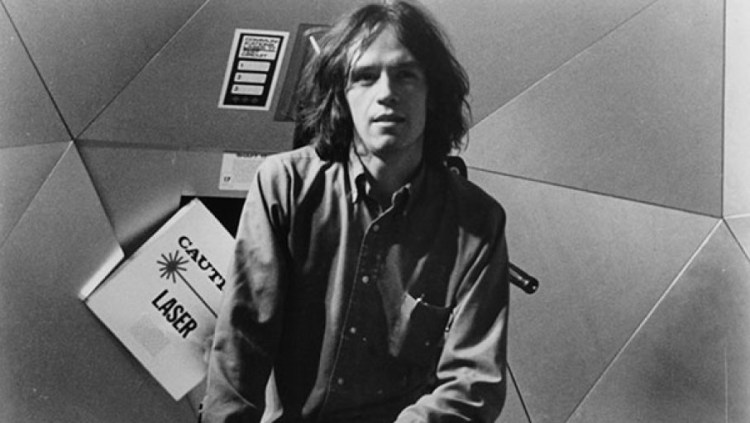
John Carpenter on the set of ‘Dark Star’ in 1974.
JW: What kind of music?
JC: We did all covers.
JW: Was there a favorite cover that sticks out?
JC: Well we did Procol Harum’s Whiter Shade of Pale, we did Jimi Hendrix, we did a whole bunch of unique stuff but most of what we did was rhythm and blues.
JW: So, let’s go through each song.
JC: Let’s hit em!
JW: Tell me about In the Mouth of Madness. You worked with Jim Lang on that originally.
JC: Well In the Mouth of Madness was inspired by Metallica and the Black Album. We wanted Enter Sandman for that and we didn’t get it so I just made it up and Daniel’s dad played lead guitar on it for me and it turned out great.
JW: Were you a big Metallica fan?
JC: Yeah, but my kids got me into that. I wasn’t before, I wasn’t even paying attention to them and all of a sudden they’re listening to it.
JW: What was it? The heaviness, the drama?
JC: All of it; I loved it all. The drama, yeah.
JW: What about Assault on Precinct 13?
JC: That was the inspiration of Led Zeppelin and Lalo Schifrin and that was just a repetitive piece. It really didn’t do very much, it was just very crude. The string part was a semi tone out of tune which I didn’t realize until later and it kind of made it creepier being slightly out of tune.
JW: Led Zeppelin have a massive catalog what was it about Immigrant Song?
JC: Just the riff, dun dun da dunum.
JW: Were you ever into mythological stuff?
JC: Eh, maybe not? I didn’t pay much attention.
JW: Were you drawn to more epic things from your childhood or epic tales?
JC: I like all tales, epic tales, small stories. I like everything, it’s the same with music.
JW: Were there any peers that you had while you were making these films in the 70s and 80s that you had a friendly competitive rivalry with?
JC: No, not at all, it was all done alone pretty much, except the guys who turned the machines on and recorded it, you know the engineers. I just did what I thought had to be done for the scene. That was my job, just provide the sound and the music for the particular scenes in movies. I had a great feel for the movies because I grew up watching them. Cinema was my first true love and it still is.
JW: So then we have The Fog.
JC: That actually went through a couple on incarnations. The first portions of the score I did I threw out and went back and recorded something new to make it lighter, because the fog is light. The fog is kind of wispy and insubstantial so I wanted something to go along with that.
JW: And for the actual song that appears on the album, how did you guys approach it?
JC: Just by listening to what I had done back them and modernizing it all. Just bringing it into modern day.
JW: What does that entail?
JC: Modernizing the sounds and learning how to play it again.
JW: I know you’ve said you never re-watch any of your movies
JC: I don’t want to
JW: Do you ever catch them on T.V. or anything?
JC: I occasionally go by and I’ll see something I recognize and I’ll move on. Quickly (laughs).
JW: Do you remember making much of these
JC: Oh sure I remember everything! Every mistake, every screw up, I remember it all.

Director John Carpenter (R) and makeup artist Frank Carrirosa on the set of ‘They Live’ in 1988.
JW: Did you have a creative process when it came to making these or did you just watch the films or a particular scene on loop?
JC: It would be on a television set, we’d have the movie cut together on tape, I would sync up the synthesizer to the movie and we would just play along with it. I would just play track after track looking at the image and that was the best way I could do it.
JW: Were these all one take or did you think “hmm I like that part?”
JC: These were always A to B and B to C.
JW: Lots of trial and error?
JC: Sometimes but mostly I would just start going. “Let’s do it, let’s get this song going!”
JW: And then Prince of Darkness.
JC: It was a unique score and I’m really proud of that one. That’s some of the scariest music that I’ve done. The choral voices are fun, I loved those. The darkness of the piece. I can’t tell you who inspired the music but I know the movie Prince of Darkness was inspired by a Dario Argento film called Inferno. It was his freedom when he made Inferno, logical freedom. He said “nothing makes sense and I don’t care” and I thought “Oh that’s great. That’s real freedom.”
JW: And Goblin inspired a lot of…
JC: Oh, Goblin’s awesome. Simonetti is awesome.
JW: In what ways do you think that seeped into what you were doing?
JC: Well I just have to fight against ripping it off because it’s so great. Suspiria is one of the greatest scores of all time. Oh my god… Oh my lord.
JW: When you heard it for the first time were you thinking “Alright I need to do something that rivals that.”
JC: No, I was never that competitive, I was also used to a certain style from Italian composers. There was a certain style going back to the 50s and 60s and it’s an Italian sound, I can’t describe it.
JW: Santiago (Vampires) score?
JC: A movie called Rio Bravo has a piece of music that influenced that plot. Dean Martin, John Wayne and Walter Brennan were stuck in this jail and outside the jail the bad guys are having these musicians play a Degüello, which is what the Spanish played at the Alamo. Dimitri Tiomkin wrote a new version that’s not Degüello at all but a version of it so I wanted something like that for Vampires and that’s where Santiago comes from. And it’s also western influenced.
JW: Were you one of those people that’s fascinated by the occult on a real level?
JC: No, it’s all fake. Real life is here.
JW: Did you always have a vivid imagination as a child?
JC: I did and I was attracted to the science fiction and horror of the times, I just loved them.
JW: HG Wells?
JC: A little bit but I was more influenced by Lovecraft.
JW: Escape from NY?
JC: That was something I started developing on the piano. I started playing that theme months before recording it and it was there so I used it for the main title. Something bad is coming. It’s in the future and it’s bad…That was the main feel of it.
JW: Were you living in New York at the time
JC: No I’ve never lived in New York. I wouldn’t. Are you kidding me? Please…
JW: It was inspired by the Watergate dystopian vibe of the period?
JC: Vietnam was the darkness at home. All the guys my age were afraid they were gonna send us over to die.
JW: Did you have a good draft number?
JC: I did and I got out. I think that’s probably where it came from, the helicopters are Vietnam reminiscent machines. But really the inspiration was much more fantasy oriented. It was a combination of Death Wish the Charles Bronson movie which I enjoyed and this novel by Harry Harrison, Planet of the Damned where the basic story is: it’s the toughest place on earth who do you send in? The toughest guy.
JW: Some of these songs are 30 years old, does it bring back emotions from when you were working on the songs or take you back to those moments when you were making those films. And what did this particular score bring back?
JC: Oh yeah, I remember a lot of things. St. Louis Missouri is where we shot Escape From New York and I remember these really hot nights there. It was the perfect place because it had burned during the 70s so it was burned down.
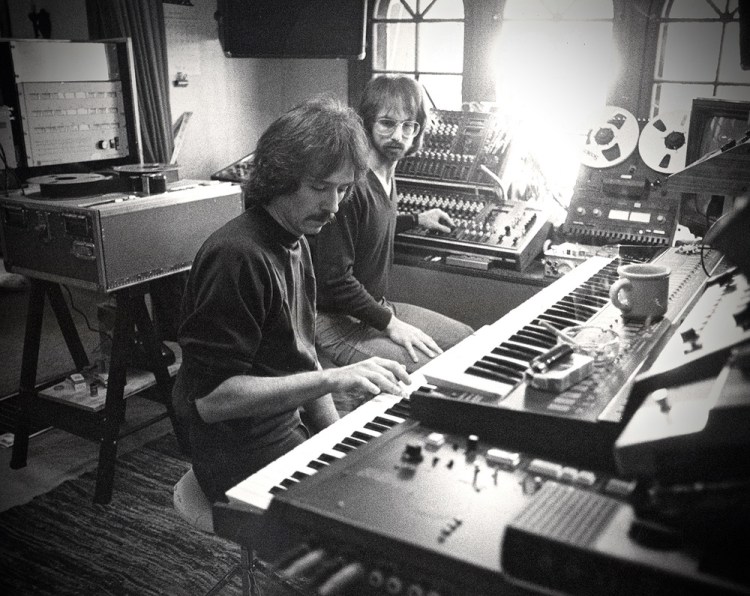
John Carpenter (left) and Alan Howarth in Howarth’s Pi West Studio in 1980.
JW: Were you recording the music in LA mostly?
JC: Yeah
JW: How did you approached the re-recording of Escape From New York with your son and godson?
JC: Well we just started listening to the old version. And the hardest thing to get was the arpeggiator, we had to copy it exactly because that was an old arpeggiator that I would play and it would skip around in its arpeggiation. It’s a unique sound so we re-created that. It was fun and again the instruments now are so much brighter and richer than they were in those days.
JW: Is that inherently a good thing. I think a lot of artists now have a nostalgia for those more analog sounds.
JC: Not me.
JW: Halloween?
JC: That’s the bongo story. My dad taught me 5/4 time and that’s where it came from.
JW: Did you have any idea when you wrote that that it was going to kind of…
JC: No, clueless, completely clueless.
JW: With any of these were you dissatisfied with the original and think you improved on it?
JC: Never thought of it that way. With something like Assault on Precinct 13 which was very primitive and crude we rearranged the sounds in different ways slightly but I never thought when I was recording this stuff that I would in my late 60s be standing up in front of an audience and playing it, I just never believed it.
JW: Porkchop Express (Big Trouble in Little China)?
JC: I Just Got Paid Today by ZZ top that’s the whole vibe of it. I love them.
JW: They Live?
JC: The blues. There is nothing political about the music but the movie was political. It is just this working guy who comes into Los Angeles looking for work and the blues is just the perfect thing for it.
JW: Did your perception of LA come into it? You’ve lived here for so long.
JC: Well LA is like America, its everything you want, its down and out, its rich, its poor, the most beautiful girls in the world, the beaches, the mountains, the snow if you look for it. And the people it’s got everything, it’s got crime, it’s got happiness, it’s got sadness. Everything you can think of.
JW: The Thing?
JC: We are playing Morricone’s main title. He wrote something as simple and minimal as the stuff I was doing because that’s what I wanted. I wanted something simple and minimal to go against some of the scores that were happening. And he did really lush orchestral stuff for me in that movie I’m very happy with it.
D: Did you strike up a friendship?
JC: Yeah, he is a very nice man, didn’t speak English and I didn’t speak Italian.
JW: Starman?
JC: Jack Nitzsche did it. A legendary character in the music business, was a session man and piano player for the Rolling Stones; he wrote a lot of early rock stuff. He was recommended by Michael Douglas. It’s a love story theme and we don’t have many of those so we get to play that.
JW: Pretty starkly different, was the approach different?
JC: My son had jetlag coming back from Japan so he woke up at 4 in the morning and laid down the tracks and we just cleaned it up a little bit and added various sounds.
JW: Darkstar?
JC: Well it was Bernard Herrmann oddly enough. My god that was a long time ago, I was so naïve and I hear it in the music.
JW: How were you able to alter it in this version?
JC: My godson Daniel really altered it and modernized it and improved it.
JW: Christine?
JC: The movie had George Thorogood and the Destroyers doing Bad to the Bone as the title music and it had a lot of 50s music in it. I did the incidental stuff. And the Christine version is the incidental stuff I did made into a rock and roll song.
JW: Did that allow you to come full circle?
JC: It was just fun.
JW: What was the most fun apart about it?
JC: Just that the song has a real cool spirit to it.
 Aesthetic Magazine | Album Reviews, Concert Photography, Interviews, Contests
Discussion
No comments yet.