By: Colin Rabyniuk –
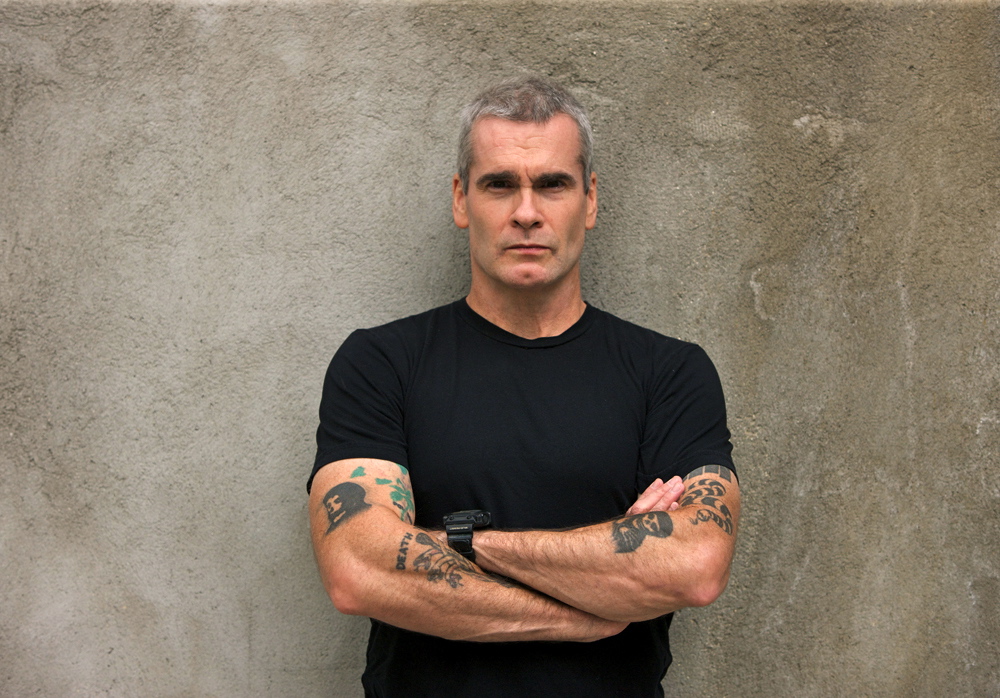
Henry Rollins (Photo: Heidi May)
H enry Rollins no longer broods barefoot on stage, howling with supreme consternation, his body clad only in gym shorts, gyrating to the rhythm of the drums when he performs. He doesn’t stare bleakly into the crowd anymore, his face wrought with dismay. Fans no longer pelt him with bottles and slurs. They don’t try burning him with lighters or punching him in the face. And the cops don’t interrupt his sets or cancel his shows.
These days the 51-year-old spoken word artist plants himself firmly at the front of the stage, his feet spread wide, the mic chord wrapped loosely around his hand. He tells jokes now, and shares some of his incredible stories. If the night is right, he might quote Abraham Lincoln, his favourite American. It’s likely he won’t stop for water; no time for breaks in his nearly three-hour set. After the show, Rollins will head outside the venue to meet his lingering audience. He’ll shake hands and sign autographs. If not for the faded batch of tattoos running down his arms – the iconic Black Flag symbol appears just below his t-shirt sleeve, the Misfits skull on his forearm – you might not recognize him. And though the physical act has aged and the tone of his message softened, to Henry Rollins, not much has changed.
From Nov. 19 to 21, Rollins will bring his signature honesty and conviction to Toronto’s prestigious Glen Gould Studios as part of his Long March Residencies series, the final leg of this year’s Long March Tour. He’s been performing in Toronto since the early ‘80s and says he always enjoys his time in the city.
“Oh, I like Toronto,” says Rollins in a phone interview. “It’s a very beautiful city. Lots of nice people, very respectful. I’m sure there are some duds in Toronto, as there are in every city. For the most part, though, my audience there always seems like a very switched on crowd.”
“I don’t do much else besides work. I don’t have many relationships – a girlfriend, a wife – to keep me away from my work, so I get a lot done that way.”
At the end of the year, Rollins will have played about 185 shows across four continents. On top of that busy itinerary, he’s also kept up with his Saturday night radio show and his column in LA Weekly. Prior to the US presidential election, Rollins embarked on an ambitious tour of all 50 US state capitals. Partnering with the activist website takepart.com, Rollins hosted a series of videos centered on the history and culture of each tour stop.
“There’s no secret [to getting so much done]. You just focus on each project. You do one then another then another. A lot of preparation goes into these things too. You work to avoid any whoops moments so nothing catches you by surprise. I don’t get high so I never have to pull myself up off my face the next morning. That helps. You just have to get unlazy about these things,” he said.
His solitary nature, he says, also helps him focus on the task at hand. “I don’t do much else besides work. I don’t have many relationships – a girlfriend, a wife – to keep me away from my work, so I get a lot done that way.”
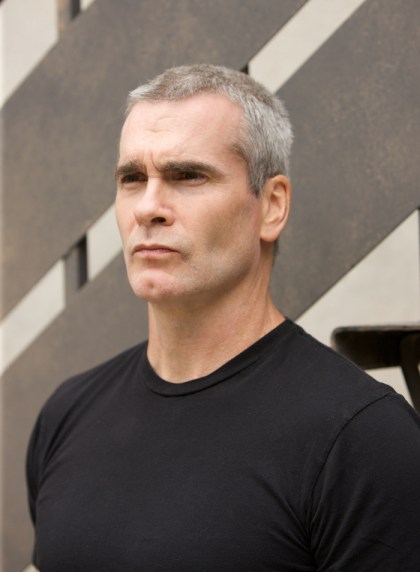
Henry Rollins (Photo: Heidi May)
Growing up, Rollins never expected much for himself. “I pictured dead-end jobs at minimum wage. I did not see much of a future for myself,” he said. Raised by a single mother in Washington, DC’s affluent Glover Park neighbourhood, Rollins attended the Bullis School, an all-male prep school who he credits with developing his discipline and work ethic. It was a tumultuous time for Rollins, though. In a 1994 article for Details Magazine Rollins described his state of mind growing up. “When I was young,” he wrote, “I had no sense of myself. All I was, was a product of all the fear and humiliation I suffered. Fear of my parents. The humiliation of teachers calling me “garbage can” and telling me I’d be mowing lawns for a living. And the very real terror of my fellow students.”
By the age of 20, and after finding a gig managing an ice cream parlour, Rollins’ life had seemingly run its course, a mundane cycle of hirings, firings and scooping ice cream. It was around this time that he first met Black Flag. “I wish it hadn’t opened my eyes so much and made me see so clearly,” Rollins wrote in his seminal book Get in the Van. “I saw my life stretching out in front of me. Same town, same people, same everything. I felt as if I was getting tied down and beaten by life. [Black Flag] had guts. The way they were living went against all the things I had been raised to believe were right. If I had listened to my father I would have joined the Navy.”
A short time later, in June of 1981, Black Flag invited Rollins to join the band. He would replace lead singer Dez Cadena, who was shifting over to rhythm guitar.
For Rollins today, his life is a far cry from the dead end, minimum wage jobs he envisioned for himself as a teen. A self-described creature of opportunity, Rollins takes whatever work he can get. That means roles in feature films and television shows. Last year he narrated a series of documentaries for National Geographic about mankind’s relationship to deadly animals. He had a recurring role as white supremacist A.J. Weston on FX’s acclaimed show Sons of Anarchy. In the mid-2000s, IFC gave him his own short-lived, late-night talk show called The Henry Rollins Show. After winning a Grammy for Best Spoken-Word Album in 1994, he made regular appearances on MTV and VH1. And under his 2.13.61 publishing company, he churns out books almost yearly. His latest book, Occupants, compiles his writing and photography from recent trips to dangerous locales like Iraq and North Korea.
Rollins wrote one of his earliest books, Eye Scream, as a way to document the ferocity, cruelty and oppression he found in society and in himself. “I wanted to create a book that brought the whole thing to a boil and see where it left me off” he wrote on the back cover. “My work now is about the same,” Rollins told Aesthetic Magazine. “I observe, I interview, I find things out, and then I get out of there. And by getting out of there you gain a lot of perspective on what you just saw.”
Getting out, it seems, is paramount to Rollins. He visits between ten and 25 countries every year. Some of those stops are for work, others are personal fact-finding missions. Next year, Rollins plans to head back to central Asia. “I want to see more of the ‘Stans,” he says. “Kyrgyzstan, Tajikistan. Turkmenistan would be really interesting. It’s one of the last untapped oil reserves in the world so there’s lots of Canadian, American, European interests trying to get their straws in there.”
“I observe, I interview, I find things out, and then I get out of there. And by getting out of there you gain a lot of perspective on what you just saw.”
Rollins has spent most of his adult life on the road and those travels have afforded him a unique perspective. To him sharing that perspective is not a duty or a chore. “I don’t see it as a responsibility,” he says. “I’m not a teacher or professor, some kind of educator. I think it’s just something to do. Lincoln said, ‘Let those materials be molded into general intelligence, sound morality, and, in particular, a reverence for the constitution and law.’ To me, that’s the baseline. I think that just gets you in the door. I’m working on my extracurricular activities now.”
The Long March will come to an end later this month with five nights at Largo’s in Los Angeles. After that Rollins plans on working on “book stuff” and listening to the new records he collected on the road. “I try to listen to between three to five records every day when I’m home. It sounds like a university class but it’s true. It’s nice to have a chance to listen to these things at least once.” It speaks volumes that even Rollins’ time off is so finely regimented.


Discussion
Trackbacks/Pingbacks
Pingback: Colin A. Rabyniuk | Context » Updates and stuff - December 1, 2012