By: Patrick Topping (@ptopp_ing) –

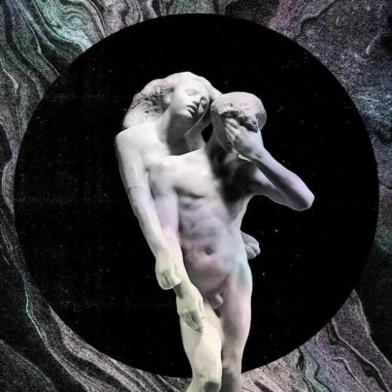
Arcade Fire’s Reflektor is the newest outing from everyone’s favourite band to love, and love to hate. And it’s okay to love to hate them, because right now, Arcade Fire feel pretty ambiguous about Arcade Fire. Following the pervasiveness of 2010’s The Suburbs, the Montreal-based collective were thrust across a rare threshold whereby the band’s closely-insulated image and music was no longer theirs, but rather an ornament of pop culture. In response, the ensemble led by Win Butler and Régine Chassagne shirked theArcade Fire identity opting to perform as the Identiks in December 2012 (broken identity) and most recently as the Reflektors, costumed in white-suites adorned with panache and wearing streaked-black makeup. Furthering the split-personality effect, caricature imitations of Arcade Fire members with over-sized masks appear as a side attraction at live shows.
The new double-disc album is a divergence from the band’s anthemic indie rock fingerprint, offering a diverse and sonically dense neon-tinged synthesis of art-glam rock and nu-disco grooves, with an undercurrent of Caribbean percussion rhythms. Thematically following The Suburbs‘ warm, bleary-eyed glimpse at adolescence, Reflektor is a glassy, matured, and exasperating realization of unfulfilled expectations and broken identities of adulthood in the 21st century, expressed through lyrically intertwining digital malaise, depictions of a rebuilding Haitian people, and the tragic Greek mythology of Orpheus and Eurydice. For the construction of Reflektor, the band finds an ally in James Murphy, the former frontman of the foremost cover band of pop-obscurest material as LCD Soundsystem. Murphy brings weighted, surging synths to the heady concoction but unfortunately, his presence seems more a tacit endorsement for repurposing the sonic blueprints from Roxy Music, Lou Reed, David Bowie, and the Talking Heads.
The explosive leading track “Reflektor” bursts open with a strident, flickering disco beat, propulsive padded Latin percussion, syncopated arpeggiateor synth hooks, and powerful guitar strikes, the lyrics touching on the album’s narratives of confining contexts, deflected communications, and false projections, most notably of the “resurrector”, played by David Bowie. Continueing the afro-grooves, the disco-synth We Exist” starts with an analogous “Billy Jean” rhythm and high-soaring strings that build as Arcade Fire inject their hallmark grandiosity. Caustic lyrics serve as an accusatory plea for an oppressed or ignored people against an ominous persecutory force: “We know that we’re young / And no shit we’re confused / But will you watch us drown? / What are you so afraid to lose?” The track peaks with unwieldy throttled instrumentation, unfortunately overwhelming the song.
Buoyantly psychotropic “Here Comes The Night Time” ignites with a hurried Carnivale rhythm and searing guitar licks, before time-shifting to a languorous half-time groove buoyed by a warbled synth bass, as Butler impishly sings “If you’re looking for hell, just look inside” and later “when you look at the sky, just try looking inside, god knows what you might find,” encouraging introspection to discover nascent capabilities for good and evil. On the bluesy Stooges-inspired punk song “Normal Person” stumbles to its feet as Butler sighs while asking an audience if they “like rock n roll music”, expressing an underwhelming uncertainty at the entire lifestyle. On the jangly “You Already Know”, bookended by Jonathan Ross announcing the band as Arcade Fire, the lyrics delve into conclusive inevitability as the instrumentation subtly frays at its seams, a nuanced touch that hints at a sense of hackney in the band’s identity.
On the contemplative second half of the album, the pairing of the plaintive “Awful Sound (Oh Eurydice)” and “It’s Never Over (Hey Orpheus)” are a high-point in the narrative, the former grounded in percussive bass and acoustic guitar, with ethereal rounded synths and orchestral strings intertwining towards a claustrophobic apex before landing onto a 10cc-styled refrain. On “It’s Never Over (Hey Orpheus)”, the hurried pacing of the warbled electro-synth bass, strident flickering rhythms, and scraping guitar lines to the hushed choral refrains are a strong dynamic balance. The lyrics in the pair touch on the mythology in which the near-deity musician Orpheus nearly saves Eurydice from the underworld by leading her by the hand until he glances back at the brink of the mortal realm, violating the condition of her freedom and losing her to the underworld forever.
Nearing the end, the band struggle to find a punctuative mark with “Afterlife”, the chirpy synth led indie-pop song with a shuffled rhythm and a surging chorus akin to the “Sprawl II”, while the breathy, pulsed-keyboards, and whirled fluttered arpeggiations on “Supersymmetry” bring the massive album to a light and tender close.
Since establishing themselves as a powerful act with their debut album Funeral, Arcade Fire have ardently forged their own path without regard for external forces, and on Reflektor, they expand on an even wider breadth of territory. But as with Neon Bible and, yes, the Suburbs, they have tended towards an exhaustive “more is more” principle, often leaving less-strong material on record. Because Reflektor is a smattering of derivations that ultimately forgoes songcraft in favour of wallowing in the extensive mired grooves, a balance to the tremendous creativity is sorely needed to bind all of the elements into a concise statement. Without this balance, the album is rendered unwieldy. Much like the oft-debated impulse for Orpheus to glance backwards, whether it was vulnerable insecurity or boastful pride, the lack of balance inhibits the strong strains on the Reflektor from being bound into a masterful work.
Essential tracks: “We Exist”, “Normal Person”, and “Awful Sound (Oh Eurydice)”
 Aesthetic Magazine | Album Reviews, Concert Photography, Interviews, Contests
Discussion
No comments yet.